










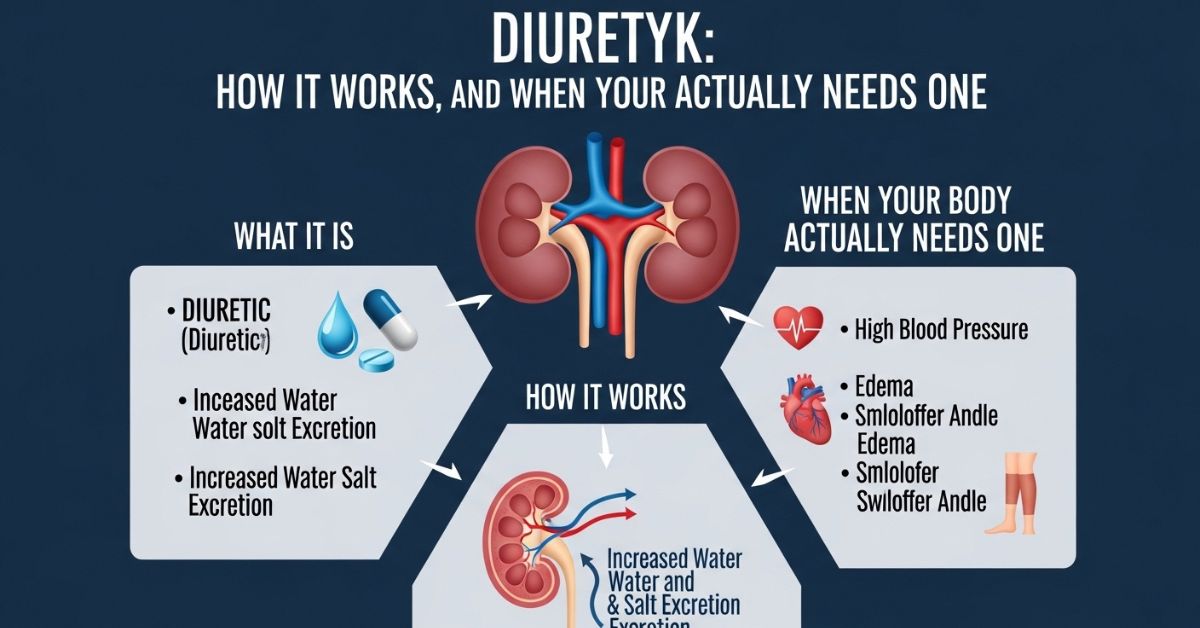
Imagine this: you put on your shoes first thing in the morning and notice that they are much more snug than they were the night before. Your ankles appear swollen. You sense a weight on your face. Although you consume water, it appears as though your body is storing every last drop, as if it were bracing for a drought. Shortly after your appointment to the doctor, you will receive a prescription that includes the term “diuretyk,” which you might not be familiar with.
It has a clinical tone. Perhaps even frightening. But if you know what a diuretyk is and why it’s important, you could reevaluate your perspective on kidney health, the fine fluid balance your body strives to preserve daily. Allow me to explain everything in plain English.
What Exactly Is a Diuretyk?
In medical terminology, a diuretyk, also known as a water pill, is any chemical that causes your kidneys to generate more urine than usual. The phrase originates from the Greek “diourein,” meaning “to urinate.”. This aids the body’s natural process of eliminating excess salt and moisture.
You have remarkable kidneys. Roughly 180 liters of blood are filtered daily by these organs, with essential substances retained and waste products eliminated by urine. The kidneys are stimulated to eliminate more water and electrolytes when a diuretyk is added to the mix. And what was the outcome? Reduced fluid retention in the body’s tissues and blood vessels—a necessary state for many medical concerns.
The Different Types of Diuretyk — They’re Not All the Same
Every diuretyk has its own unique mechanism of action and level of potency. Each kind of diuretic works by blocking a specific valve in the kidneys, which are like a series of pipes connected in a network. What follows is essential information:
Loop Diuretyk
The big guns are here. The most well-known example is furosemide, which is marketed as Lasix. Rapid action (typically within an hour) and potent enhancement of urine production are hallmarks of a loop diuretyk. When treating life-threatening illnesses such as acute pulmonary edema, heart failure, or renal dysfunction, doctors often turn to these. They get things done, and they get what they want.
Thiazide Diuretyk
Thiazide diuretyks are preferred for the management of hypertension since they are less harsh and have a longer duration of action. One of the most popular options is hydrochlorothiazide. Most people have little to no side effects with them, and they’re inexpensive and supported by decades of clinical research. If your doctor has prescribed a diuretyk to treat your hypertension, this is likely the sort they will prescribe.
Potassium-Sparing Diuretyk
This is the family to which spirolactone belongs. This diuretyk works as its name implies by removing extra fluid without reducing potassium levels in the body. This is significant since low potassium levels can lead to weak muscles, cramps, and potentially fatal cardiac rhythms. To ensure a healthy electrolyte balance, doctors typically combine them with harsher diuretics.
Osmotic Diuretyk
Here, Mannitol is the prototypical case. For medical emergencies such as a swollen brain, severe renal damage, or dangerously high ocular pressure, this diuretyk is usually kept for the hospital. This one is not available at your local drugstore.
When Does a Doctor Actually Prescribe a Diuretyk?
There are obvious and precise reasons to employ a diuretyk, and it isn’t thrown at every problem. Among the most prevalent are:
Millions of patients across the world rely on thiazide diuretyks as their first line of defense against high blood pressure because of their ability to reduce the amount of blood in circulation.
In heart failure, fluid builds up in the lungs and limbs because the heart is unable to pump blood properly. The harmful accumulation is quickly removed with a loop diuretyk, providing much-needed relief.
Liver cirrhosis: Ascites is a disorder where fluid collects in the belly due to severe liver dysfunction. To aid in the excretion of this surplus, a diuretyk is brought into action.
Kidney disorders: Water and salt retention is a symptom of several renal disorders. Balance may be restored with a diuretyk that is properly chosen.
Kidney stones: In patients predisposed to the development of certain types of kidney stones, thiazide diuretics can decrease the amount of calcium in the urine.
Side Effects of a Diuretyk — What No One Tells You Upfront
The chat about potential side effects is usually the first to go when people are in a haste to get out of the doctor’s office. I say we have it the right way.
Electrolyte loss: In addition to excess fluid, loop and thiazide diuretics eliminate potassium and magnesium. Weakness, cramps, and irregular heart rhythms can result from low potassium levels. To help your body absorb the medicine, your doctor may recommend eating meals high in potassium or taking a supplement.
Dehydration: Here, “too much” is the case. Particularly in warmer climates or among the elderly, excessive peeing can cause low blood pressure, dizziness, and dehydration.
Elevated uric acid: Painful gout episodes can be triggered in susceptible persons by some diuretics that boost blood levels of uric acid.
Blood sugar changes: Thiazide diuretyks have the potential to modestly increase blood glucose levels, hence it is important for those with diabetes or pre-diabetes to closely check their blood glucose levels while taking the medication.
Natural Diuretyk — Can Food and Herbs Do the Job?
People used natural remedies for gas and fluid retention long before pharmacological diuretyks were available. Although a natural diuretyk derived from plants cannot substitute pharmaceutical medicine in cases of severe disease, it can provide mild, daily assistance.
Dandelion: Ranked high among the plants studied for their diuretic properties. Research has demonstrated that dandelion leaf extract may significantly raise urine frequency without causing a decrease in potassium levels.
Caffeine: A gentle natural diuretyk, your morning coffee is more than simply a habit. A person’s urine production is enhanced when they consume caffeine because it prevents the kidneys from reabsorb salt. The effect is small, but it’s there.
Horsetail herb: A centuries-old cure that has been practiced all throughout Asia and Europe. A frequent ingredient in herbal products meant to promote healthy urinary tract function and reduce water retention is horsetail, which has a modest diuretic effect.
Cucumber, asparagus, and watermelon: This is more than simply a list of spa services. The kidneys are able to filter them out and gently excrete the excess fluid because of their high water content and certain chemicals.
The Diuretyk and Weight Loss Myth — Let’s Set the Record Straight
People often engage in harmful activities because they falsely believe that diuretics would cause them to lose weight quickly. It is thrilling to see a two- or three-kilogram weight decrease following one. What it really is is water weight, not fat. When you drink water normally, the value goes up right away.
In the days preceding competitions, some sportsmen and bodybuilders use diuretics to make it seem as though they have lost weight. In addition to being illegal in most sports, this technique is extremely dangerous since it can lead to electrolyte imbalances, cardiac arrest, and renal damage. Prioritizing aesthetics over safety precautions is a bad decision. Although diuretics have many medicinal applications, they are not appropriate for calculating percentages of body fat.
What You Should Know Before Taking a Diuretyk
There is a deliberate medical rationale for your doctor’s prescription of a diuretyk. Follow the instructions carefully. Do not miss any doses. It is important to see your doctor before abruptly stopping. Additionally, have your blood electrolytes evaluated on a regular basis; this easy blood test might help you avoid needless difficulties.
Please think twice before self-medicating with a diuretyk for any reason, including but not limited to: swelling in the legs, reading about it online, or a recommendation from a forum member. Fluid removal isn’t the only option for dealing with swelling; a more serious diagnosis may be necessary. You should not risk your kidneys’ or heart’s health by trying to mask a symptom without first determining what’s causing it.